Measurement Made Simple: Converting Oz to Quart for Perfect Recipes
Converting Oz to Quart is an essential culinary skill that every home chef should master. Accurate measurements are crucial in cooking and baking, particularly when dealing with liquid ingredients expressed in ounces (oz) and quarts. By understanding how to convert ounces to quarts, you can ensure that your recipes turn out just right, enhancing your culinary creations. This introduction to oz to quart conversions will guide you through the necessary calculations and handy tips for precision in your kitchen. Don’t let confusing measurements hinder your cooking; instead, learn how to navigate them with ease!
When it comes to kitchen measurements, ounces and quarts are two common units you’ll frequently encounter. Ounces, which are often used for smaller quantities of liquid, contrast with quarts that are designed for larger volumes. Grasping the process of fluid ounce to quart conversion can significantly impact your cooking and baking experiences. Whether you’re measuring ingredients for soups, stews, or beverages, having a firm understanding of these units will simplify your preparations and yield delicious results. This article will delve deeper into the methods and tips for seamless measurement conversions in your culinary endeavors.
The Importance of Accurate Liquid Measurements in Cooking
Accurate measurements are fundamental in cooking and baking, as even a slight deviation can significantly impact the final dish. In particular, liquid measurements such as ounces and quarts play a pivotal role in the preparation of various recipes. Incorrectly measuring ingredients can lead to inconsistencies not just in taste but also in texture. Many home cooks underestimate the importance of precision, yet mastering this skill is vital for replicating successful recipes consistently.
For example, when you are making a complex sauce, each ounce of liquid has a corresponding weight that affects the sauce’s density and flavor balance. By getting familiar with units like ounces (oz) and quarts, you will ensure that your measurements are accurate, which results in high-quality dishes. Understanding the significance of these measurements enhances your cooking prowess.
Converting Oz to Quart: The Basics
To convert oz to quarts effectively, it is important to grasp the basic formula behind the conversion. Simply put, to find out how many quarts are in a certain number of ounces, you divide the ounces by 32. This straightforward calculation makes it easy to switch between these two common units of volume in the kitchen.
For instance, if you are in the middle of a recipe that requires you to use 48 oz of liquid, knowing the conversion can save time and ensure accuracy. By performing the calculation (48 oz ÷ 32), you find out that you’ll need 1.5 quarts. Familiarizing yourself with such conversions is essential for any cook looking to enhance their culinary skills.
Common Ounce to Quart Conversion Examples
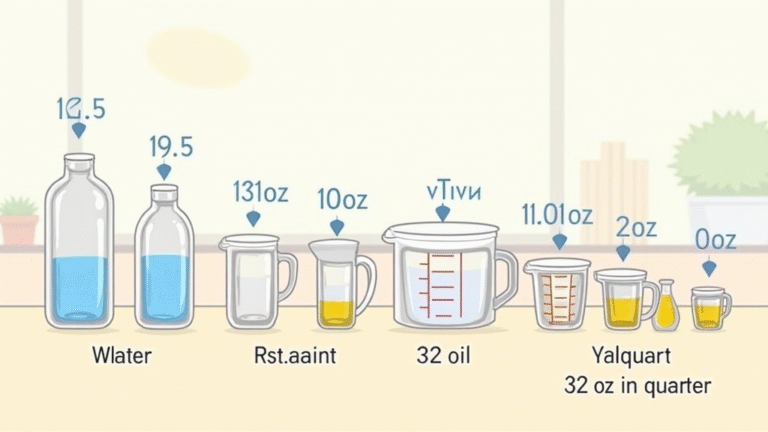
Several standard conversions from ounces to quarts can help simplify cooking processes. For instance, having a quick reference can make your cooking experience smoother. Generally, you can remember that 1 quart equals 32 ounces, which means 8 ounces equals 0.25 quarts, or 64 ounces equals 2 quarts.
These common conversions are especially useful when adapting recipes or planning large quantities of meals. If you’re preparing food for a gathering, knowing that 128 oz equals 4 quarts can help you decide how much soup to make or how many quarts of liquid are necessary for cocktails.
Best Practices for Using Conversions in Recipes
When using conversions in recipes, it’s important to practice consistency for successful results. One best practice is to keep a handy conversion chart in your kitchen, which can be consulted quickly as you cook. This passive reference allows for immediate access to key measurements and helps avoid confusion.
Additionally, consider baking scales that allow you to switch between grams, ounces, and quarts easily. By incorporating these tools, you streamline the cooking process and reduce the risk of miscalculation. Thus, every recipe can be executed with precision and impressively accurate results.
The Role of Measurement Tools in Kitchen Success
Using the right measurement tools is crucial when converting oz to quarts. Investing in good-quality liquid measuring cups, preferably those made of glass or clear plastic, ensures that you can read measurements easily without error. Transparent containers help you see the liquid level clearly, which avoids the common pitfall of overshooting the desired measurement.
For dry measurements, consider utilizing a set of measuring spoons and cups that allow for both large and small quantities to be accurately measured. Having these tools on hand not only aids in precise measurements but also brings confidence to your cooking, thereby enhancing your overall culinary experience.
Tips for Converting and Measuring Liquid Ingredients
When converting and measuring liquid ingredients, a few simple tips can enhance accuracy and efficiency. Always ensure that your measuring cups are designed for liquids, as they often come with a spout and are calibrated to allow for seamless pouring, which is essential when transitioning between ounces and quarts.
Additionally, before beginning any recipe, familiarize yourself with the conversions relevant to that dish. This can help prevent interruptions in your cooking flow and maintain a steady rhythm in the kitchen. Keeping a digital or printed conversion chart accessible is advisable for efficiency and ease.
Concluding Thoughts on Ounce and Quart Conversions
Understanding how to convert ounces to quarts is an invaluable skill for anyone who enjoys cooking and baking. By committing the conversion formula to memory, alongside the practical applications known, you can approach any recipe feeling prepared and confident. This knowledge unlocks your ability to experiment with flavors and ingredients without fear.
As you integrate these practices and understanding of measurements into your cooking routine, expect to see improvements not just in accuracy but in the overall enjoyment of the culinary arts. The combination of precise measurements and creativity is the key to bringing out the best in your kitchen endeavors.
Frequently Asked Questions
How do I convert ounces to quarts using the oz to quart conversion formula?
To convert ounces to quarts, you can use the formula: Quarts = Ounces ÷ 32. Simply divide the number of ounces you have by 32 to get the equivalent measurement in quarts.
What is the relationship between ounces and quarts when converting oz to quart for recipes?
The relationship between ounces and quarts is that one quart is equal to 32 fluid ounces. Therefore, when converting oz to quart, remember that 32 ounces make up one quart.
Can you provide a quick reference for common oz to quart conversions?
Certainly! Here are some common conversions: 1 oz = 0.03125 quarts; 8 oz = 0.25 quarts; 16 oz = 0.5 quarts; 32 oz = 1 quart; 64 oz = 2 quarts; and 128 oz = 4 quarts.
What is an example of converting oz to quart in a cooking recipe?
For example, if your recipe calls for 48 ounces of broth, you can convert it to quarts by dividing: 48 oz ÷ 32 = 1.5 quarts. So, you would need 1.5 quarts of broth.
Why is it important to convert oz to quart accurately in cooking?
Accurate conversion from oz to quart is crucial in cooking because precise measurements affect the flavor and consistency of the dish. Inaccuracies can lead to imbalanced flavors or texture issues.
What tools can help me with converting oz to quart in my kitchen?
It’s helpful to have liquid measuring cups marked with both ounces and quarts. Additionally, conversion charts or calculators can assist you in quickly finding the right measurement.
Are there any tips for measuring liquids when converting oz to quart?
To ensure accurate measurements when converting oz to quart, use clear measuring cups, level off your liquids, and consider using a scale for precision. Keeping a conversion chart handy can also simplify the process.
| Measurement | Value in Quarts |
|---|---|
| 1 oz | 0.03125 quarts |
| 8 oz (1 cup) | 0.25 quarts |
| 16 oz (2 cups) | 0.5 quarts |
| 32 oz (4 cups) | 1 quart |
| 64 oz (8 cups) | 2 quarts |
| 128 oz (16 cups) | 4 quarts |
Summary
Converting oz to quart is crucial in the culinary world to ensure precision in recipes. This conversion helps in grasping the volume measurements needed for various dishes, enhancing both flavor and texture. With the understanding that 1 quart equals 32 fluid ounces, home cooks and bakers can prevent mishaps in the kitchen by employing a straightforward conversion formula. Keeping a handy conversion chart will aid in making these measurements seamless, allowing for a more enjoyable cooking experience. Mastering this conversion is not just about numbers; it’s about elevating your cooking game to the next level.
Unlock the potential of your WordPress site with Autowp, the ultimate AI content generator and AI content creator plugin designed to streamline your content creation process. With Autowp, you can effortlessly produce high-quality articles, blog posts, and web content tailored to your audience’s needs. Transform your ideas into engaging written content in just moments, enhancing your site’s visibility and engagement. Don’t miss out on the future of content creation! To remove this promotional paragraph, upgrade to Autowp Premium membership.